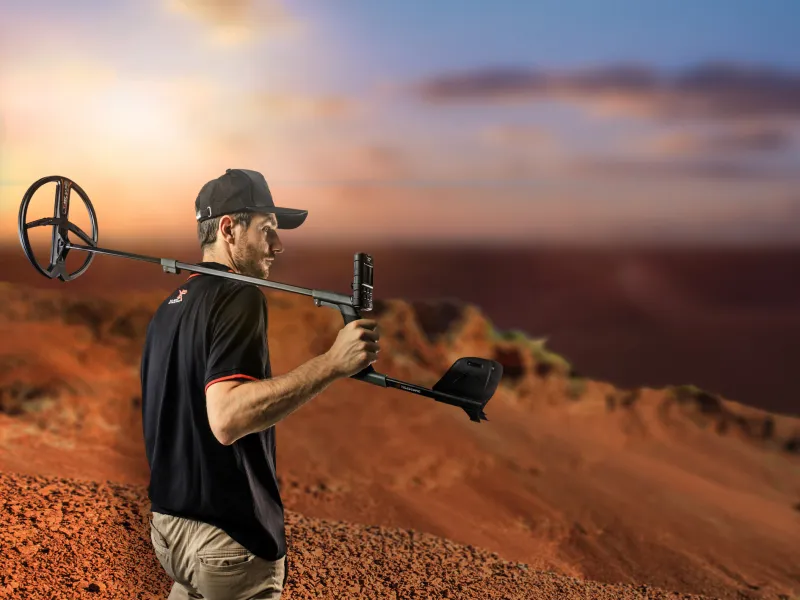
XP Deus II 28 FMF RC WS6 ST review – performance, features & experience
XP DEUS II 28 FMF – RC + WS6 ST + S telescopic shaft
Wireless high-end metal detector with Fast Multi Frequency & true stereo headphones
The XP DEUS II 28 FMF complete set with WS6 ST is a fully wireless high-end metal detector from France that combines the patented Fast Multi Frequency technology (FMF®) with the WS6 ST true stereo headphones. The headphones process two independent audio channels simultaneously and – together with firmware 4.0 – open up a fundamentally new listening experience: deep targets sound different from shallow ones, iron different from non-ferrous. With the current update to version 4.1, the stereo ecosystem has been expanded further: new MI-6 audio options, independent pinpointer volume control, an extended chorus effect on both channels and full compatibility of the WS6 (without ST) with stereo headphones round off the system. The set is aimed at experienced detectorists who want one detector for mineralised fields, the beach and under water. The price of 1,599 euros is ambitious, but justified by the range of technology and its longevity.
1. Overview – XP Metal Detectors & the DEUS II
XP Metal Detectors is a French manufacturer based in Castanet-Tolosan near Toulouse that has specialised in fully wireless metal detectors for years. The DEUS II is the direct successor to the original DEUS – at the time one of the first detectors in which the search coil, headphones and remote control worked entirely without cables. The second generation adds the patented FMF® technology (Fast Multi Frequency) for simultaneous multi-frequency detection and, with firmware 4.0, genuine true stereo audio. The current version 4.1 builds on this and completes ecosystem compatibility.
The complete set reviewed here is called XP DEUS II 28 FMF RC WS6 ST and contains the 28 cm double-D FMF search coil, the remote control (RC), the new WS6 ST stereo wireless headphones and the S telescopic shaft. The difference from the cheaper WS6 version lies in the headphones: the WS6 ST has a new processor architecture that processes two audio channels at the same time – the prerequisite for genuine stereo multi-processing.
2. What's in the box
| Component | Details |
|---|---|
| 28 cm FMF search coil | Double-D, carbon, waterproof, with fitted coil cover and lower shaft |
| Remote control (RC) | Shock-resistant, IP68, 700 mAh lithium battery, incl. clip holder and USB charging cable |
| WS6 ST wireless headphones | True stereo module, foldable, weatherproof (not waterproof), lithium battery, USB-C charging cable, ABS protective box |
| S telescopic shaft | 3-piece, curved, ergonomic rubber handle with armrest |
| Screw set | Coil mounting set |
No pinpointer and no carrying case included. For full field readiness we recommend the XP MI-6 pinpointer (available separately), which integrates directly into the DEUS II system and can be controlled via the RC. For diving, the optional XP DEUS II bone conduction headphones (rated to 20 m) are available – the WS6 ST headphones are not waterproof.
3. Technical data
| Feature | Value / description |
|---|---|
| Technology | FMF® (Fast Multi Frequency) – simultaneous multi-frequency, XP patent |
| FMF frequency range | 4 to 45 kHz (simultaneous multi-frequency) |
| Single frequencies | 49 selectable single frequencies from 4 to 45 kHz |
| Factory programs | 12 preinstalled + 12 user programs that can be saved |
| Waterproofing | IP68, submersible to 20 m (coil & RC); WS6 ST headphones weatherproof only |
| Wireless protocol | Patented XP digital protocol – approx. 10× faster than Bluetooth |
| Search coil (set) | 28 cm double-D FMF, carbon, approx. 470 g |
| Coil battery | Built-in; runtime approx. 10 h (depending on frequency and power) |
| Remote control (RC) | 700 mAh lithium battery; runtime up to approx. 25 h; weight 150 g |
| RC charging time | Approx. 3 h (possible at the same time as other components) |
| WS6 ST headphones | True stereo, new processor, 2 independent audio channels; lithium battery; approx. 15 h runtime; approx. 82 g; USB-C; 64×64 pixel display |
| Sensitivity | 99 levels |
| Reactivity | 9 levels (0 / 0.5 / 1 / 1.5 / 2 / 2.5 / 3 / 4 / 5) |
| Volume | 10 levels – independent for RC, headphones and bone conduction version |
| Discrimination | Wide range; iron volume 6 levels; notch filtering |
| Ground balance | Ground tracking (automatic) or grabbing (manual) |
| Languages | 20 languages (incl. German, English, Polish, Spanish) |
| Firmware | Updatable; currently v4.1 (free); true stereo multi-processing from v4.0; full ecosystem compatibility from v4.1 |
| Warranty | 5 years on parts & workmanship (batteries / charging cables: 2 years) |
| Sustainability | Longtime® certified; reparability guaranteed for ≥ 10 years |
| Origin | Made in France |
4. FMF® technology: simultaneous multi-frequency explained
FMF stands for Fast Multi Frequency – a method patented by XP that transmits and evaluates several frequencies at the same time. This distinguishes the DEUS II from detectors that switch frequencies sequentially. For the detectorist this brings three key advantages:
Wider target coverage in a single pass
Different metal objects respond to different frequencies with different strength. Thin gold coins or silver jewellery are detected better at high frequencies (20–45 kHz); large iron targets or deep coin hoards respond more reliably to lower frequencies (4–10 kHz). FMF® covers both in one pass – no need to walk the same area twice.
Stability on electrically conductive ground
On beach sand saturated with sea water or heavily mineralised fields, single-frequency detectors often produce false signals and noise. Simultaneous multi-frequency can filter out conductive ground effects by subtracting frequency components. The result: a much quieter search and more depth in difficult conditions.
Flexibility thanks to 49 single frequencies
If you prefer a single frequency for a specific task – such as high frequency for small gold or low frequency for large deep targets – you can choose from exactly 49 frequency steps between 4 and 45 kHz. The FMF menu also lets you limit the maximum multi-frequency to 14, 24 or 40 kHz to adapt the behaviour to the ground.
All DEUS II components communicate via XP's proprietary digital wireless protocol, which transmits signals about ten times faster than Bluetooth. At a swing speed of 2 m/s, a Bluetooth system (40 ms latency) would indicate a target shifted by ±8 cm. The XP protocol works with much lower latency – relevant for precise pinpointing when swinging fast.
5. The 28 cm double-D FMF search coil
The 28 cm coil is the medium coil size in the DEUS II ecosystem and is considered a good all-round compromise between depth, coverage and separation. It is made of carbon, weighs around 470 g and is fully waterproof to 20 m. According to the warranty terms, the supplied coil cover must be used – damage caused by use without a cover or with a damaged one is excluded from the 5-year warranty.
On mineralised ground the double-D geometry gives a quieter signal than round concentric coils, because the detection field is narrower and better defined. This allows slightly higher sensitivity on difficult ground without excessive ground noise. The coil battery lasts approx. 10 hours – enough for a long day in the field.
Alternative coils in the DEUS II system
22 cm FMF
For very trashy sites, parks and tight areas. Better separation between closely spaced targets.
28 cm FMF ← this set
Universal all-round coil. Good balance between depth, coverage and separation.
28×34 cm FMF deep
Up to +10 % depth on coin-sized targets, +20 % on large targets compared with the 28 cm standard coil.
24×13 cm HF2 FMF
High-frequency coil (FMF 9–90 kHz, mono up to 120 kHz). For small finds and densely vegetated terrain.
6. WS6 ST – the true stereo wireless headphones
The WS6 ST is the key difference between this complete set and the cheaper WS6 version. Outwardly the difference is small – technically it is considerable: the ST module contains a new processor architecture that can process two independent audio channels at the same time . This makes the WS6 ST the prerequisite for the true stereo multi-processing that XP introduced with firmware 4.0.
What true stereo means in practice
With the stereo multi-processing menu (from firmware 4.0), the DEUS II processes two parallel signals at the same time – comparable to two detectors in one. In dual-axis mode, channel 1 runs as a classic discrimination program with adjustable reactivity, while channel 2 provides maximum depth and ground information in all-metal non-motion mode. The result: you benefit from the separation of a discrimination detector and the depth of an all-metal detector at the same time – without switching modes.
There are also further stereo audio functions that can only be used with ST headphones and firmware 4.0:
- XP Morphing: Mixes audio signals depending on depth – shallow targets sound different from deep ones, which acts as an audible depth indicator.
- Chorus effect (on both channels from v4.1): Stereo effect for very weak, deep signals. The signal sounds more spatial and present. From v4.1 all chorus FX variants are spread across both stereo channels – a more intense sound experience.
- Low Square: Bass-heavy audio type with a lower tone profile. For a calmer sound, especially suitable for mixing with other audio types. From v4.1 also available for WS6 and WSA II (XL) without ST headphones.
- Improved CH2 mode (v4.1): In static mode (channel 2), subtle pitch correction for better recognition of signal variations on deep targets.
- MI-6 audio options PITCH FX / PITCH LOW (v4.1): New stereo audio options for the MI-6 pinpointer when connected to the DEUS II. PITCH LOW also for non-ST headphones.
- Independent MI-6 volume (v4.1): The pinpointer tone can now be adjusted separately from the detector signal – more control without compromising the search tone.
Three operating modes of the WS6 ST
WS6 ST as slave
The RC is the master and controls all settings. The WS6 ST serves purely as stereo headphones.
WS6 ST as master
The WS6 ST controls the coil directly, takes over all settings and displays targets. Ideal for a light set-up without the RC.
WS6 ST + WSA-ST
The module mounted on the shaft as the control unit, combined with wireless WSA ST or WSA XL ST headphones.
WS6 ST key specifications
| Property | Value |
|---|---|
| Audio channels | 2 independent stereo channels (true stereo) |
| Processor | New microprocessor architecture (compared with WS6) |
| Display | 64×64 pixels; ferrous/non-ferrous indication, target ID, battery level, program |
| Battery life | Approx. 15 hours |
| Charging time | Less than 3 hours (USB-C) |
| Weight | Ca. 82 g |
| Weather resistance | Rainproof / weatherproof (not waterproof) |
| Equaliser | 4-band audio equaliser, configurable via RC or WS6 ST master |
| Volume | 10 levels, adjustable directly on the headphones or via the RC |
| Firmware | Stereo multi-processing only with firmware 4.0 or higher |
| Compatibility | DEUS II only (RC or FMF coil as master) |
| Warranty | 2 years (battery); 5 years (housing and electronics) |
XP recommends installing firmware 4.0 only in combination with ST headphones – without them, the headset can no longer be switched on afterwards. From firmware 4.1, older WS6 master modules can also control stereo headphones via the same interface, and older mono headphones (WS6, WSA II) gain access to Low Square and the extended chorus effects.
7. Firmware 4.0 & 4.1 – what the updates bring
The DEUS II is an actively developed platform. XP delivers new features free of charge via firmware updates. Firmware 4.0 was the biggest update since the introduction of multi-frequency technology – not a stability patch, but a fundamental innovation in signal processing. Version 4.1 builds on it and completes the compatibility of the entire ecosystem.
Firmware 4.0 – core innovation: multi-processing
The key innovation is the simultaneous processing of two independent detection channels in a single swing of the coil. Both channels use the same coil and the same frequencies, but work with different settings for reactivity, sensitivity, audio character, iron filtering and motion/non-motion mode. The output is via two separate audio channels – which is why stereo headphones (WS6 ST, WSA ST or WSA XL ST) are essential.
Dual reactivity
Simultaneous operation of a slow depth channel (maximum depth) and a fast separation channel (best separation in iron/trash). Instant audible assessment of target depth and separation – without switching.
Morphing audio
Dynamic tone change depending on target proximity and signal quality. Deep iron, borderline iron and good targets sound different – an audible depth indicator without looking at the display.
Stereo chorus effect
Applied only to weak, deep signals. Deep objects gain spatial presence – better perception of faint whisper signals on heavily hunted ground.
Dual-axis detection
Channel 1: discrimination mode (motion). Channel 2: all-metal non-motion mode. Separation and maximum depth at the same time – especially for relic and archaeological searching.
Stereo panning
Free spatial placement of the audio channels: good targets in the centre, iron to the side. Faster perception, less mental load in the field.
Low Square (mono)
New bass-heavy audio type, also usable without stereo headphones. Low-frequency tone that combines well with other audio types.
Firmware 4.1 – completing the ecosystem
Version 4.1 establishes full compatibility with the entire headphone ecosystem and adds targeted stereo audio functions. All new features at a glance:
| New in v4.1 | Details & availability |
|---|---|
| WS6 controls stereo headsets | The WS6 (master, without ST) can now control the WSA ST, WSA XL ST and WS6 ST via the same interface as the RC and WS6 ST – full ecosystem compatibility |
| Low Square for all | New audio type now also available for WS6 and WSA II (XL) without ST headphones; refined square-wave audio signal with a lower tone profile |
| MI-6 audio options (stereo) | New PITCH FX and PITCH LOW options for the MI-6 pinpointer in stereo operation; PITCH LOW also available for WS6 and WSA II (XL) |
| Independent MI-6 volume | The MI-6 volume can now be adjusted independently of the detector volume |
| Improved CH2 mode | In static mode (channel 2), subtle pitch correction for better recognition of signal variations on deep targets |
| Chorus effects extended | All chorus (FX) effects are now spread across both channels – a more intense, dynamic stereo experience |
| Improved wireless connection | More stable wireless connection to coils and MI-6; increased robustness in demanding environments |
| XTREM HUNTER updates | Includes various fixes and improvements relating to the XTREM HUNTER |
The update to v4.1 is free and available via the official XP updater at updater.xpmetaldetectors.com . Before updating, XP recommends noting down all user programs, as they are deleted during the update. The remote control and headphones must be updated separately; the search coils do not need an update.
8. Remote control (RC)
The remote control is the central control module of the system. It is built into a shock-resistant solid rubber housing, IP68 certified and waterproof to 20 m. With a lithium battery (700 mAh) and a runtime of up to 25 hours, it is the longest-lasting component in the system – a full day in the field is easily possible without recharging.
The RC weighs 150 g and can be carried on the shaft with a clip or in the supplied belt pouch, which takes the strain off your wrist on long outings. All relevant parameters are directly accessible via the RC: 99 sensitivity levels, 9 reactivity settings, discrimination, iron volume, ground balance (automatic or manual), frequency, audio format and expert functions such as notch filter, threshold and signal amplification. Plus 20 languages and access to all 12 factory programs and 12 user programs that can be saved.
9. S telescopic shaft and ergonomics
The 3-piece S telescopic shaft with its characteristic curve in the upper section keeps the search coil closer to the ground when swinging and noticeably relieves the wrist compared with straight shafts. The rubber handle with armrest sits securely in the hand even when wet. Thanks to the fully wireless technology, the DEUS II can be assembled and dismantled in seconds – no threading cables, no connectors on the coil.
The total weight of the detector starts at approx. 750 g (22 cm coil, WS6 ST as headphones, without RC). With the 28 cm coil and the RC on your belt, it comes to approx. 815 g – a remarkably low figure for a complete high-end system.
10. In the field – strengths and limitations
- True stereo multi-processing with WS6 ST – audible depth indication without looking at the display
- FMF® simultaneous multi-frequency: universal in fields, on the beach and under water
- 28 cm coil: good balance of depth, coverage and separation
- Extremely low total weight, fully wireless
- Remote control: up to 25 hours of battery life
- Active firmware support: v4.0 stereo multi-processing, v4.1 full ecosystem compatibility – free of charge
- 5-year warranty, Longtime® certified, reparability ≥ 10 years
- Coil and RC IP68 – submersible to 20 m (diving with optional bone conduction headphones)
- Price: EUR 1,599 – clearly aimed at advanced users
- No pinpointer and no case included
- Full stereo multi-processing only with firmware 4.0+ and ST headphones; v4.1 update recommended before use
- Learning curve: many settings need experience to reach full potential
- Coil battery cannot be swapped in the field – a USB power bank is recommended
11. Market positioning
In the high-end segment the DEUS II competes with the Minelab Manticore (EUR 1,999) and the Minelab Equinox 900 (approx. EUR 800–900). Compared with the Equinox, the DEUS II offers a much wider frequency spectrum, more consistent wireless design and lower weight. The Manticore scores with its 2D target identification and is easier for beginners to operate. Compared with Nokta detectors such as the Legend (approx. EUR 500–700), the DEUS II offers the more extensive coil ecosystem, a much longer warranty and the superior stereo audio system.
The WS6 ST clearly sets this set apart from WS6 configurations: if you want to use stereo multi-processing, you need ST headphones. If you can do without this function, you can choose the cheaper WS6 version – but you will miss out on one of the most significant DEUS II innovations since its launch.
12. Rating
| Criterion | Score | Comment |
|---|---|---|
| Detection performance | ★★★★★ | Excellent depth and separation |
| Stereo audio (WS6 ST) | ★★★★★ | True stereo is unique in this segment; real added value |
| Frequency flexibility | ★★★★★ | FMF® + 49 single frequencies, wide spectrum |
| Ergonomics / weight | ★★★★★ | Lightest high-end concept on the market |
| Ease of use | ★★★★★ | Many options; learning curve for beginners |
| Battery life | ★★★★★ | RC 25 h, WS6 ST 15 h, coil 10 h – fit for the field |
| Waterproofing | ★★★★★ | Coil & RC IP68 to 20 m; headphones weatherproof only |
| Scope of delivery | ★★★★★ | No pinpointer or carrying case included |
| Best value | ★★★★★ | Ambitious, but justified by the technology |
| Build quality | ★★★★★ | Carbon coil, rubber RC housing, 5-year warranty |
13. Conclusion
The XP DEUS II 28 FMF RC WS6 ST Komplettset is currently one of the most technically mature wireless metal detectors on the market. The combination of FMF® multi-frequency, the WS6 ST true stereo headphones and an actively maintained firmware platform results in a system that keeps developing with free software updates – a clear advantage over static detector generations.
The firmware development shows that XP is consistently pursuing this path: version 4.0 introduced a fundamentally new quality of audible target analysis with stereo multi-processing. Version 4.1 extended this system to the entire headphone ecosystem, added new MI-6 audio options and improved connection stability. Anyone buying a DEUS II system with WS6 ST today gets access to all these functions – including future updates.
For occasional detectorists with no experience in configuring a detector, there are more beginner-friendly alternatives. But if you search regularly in changing conditions, take your equipment seriously and are prepared to unlock the potential of a complex system, the DEUS II will serve you well for many years.
Contact
Metalldetektoren.de
Andreas Licht
Professor-Derra Str. 3
96465 Neustadt b. Coburg
Germany
Our service
Information
- Delivery time
- Payment & shipping
- My quick purchase
- Privacy and data protection
- Authenticity of customer reviews
- Terms and conditions
- Battery Act notice
- Cookie settings
Our brands