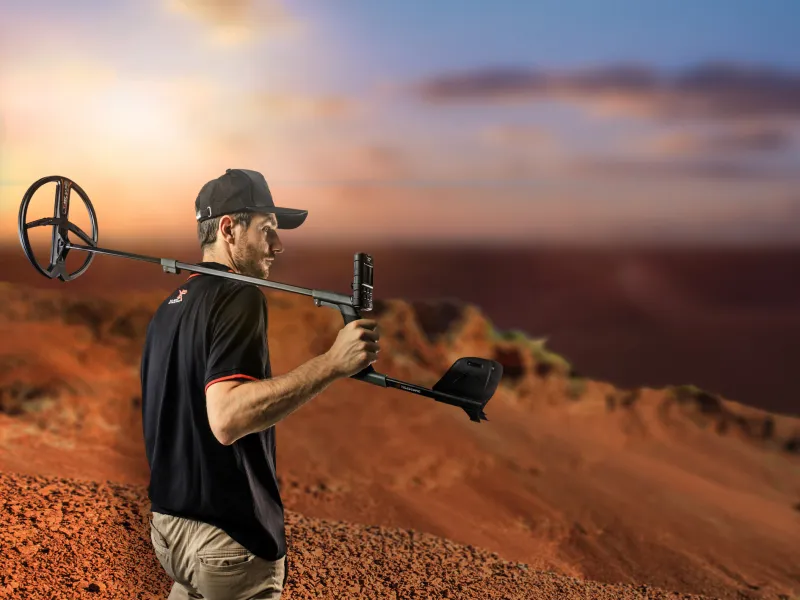
Review: XP DEUS II V4.1 with ST headphones – WS6 ST / WSA ST / WSA XL ST
XP DEUS II with V4.1 – WS6 ST, WSA ST & WSA XL ST: the stereo ecosystem in the field
Three new stereo wireless headphones, two independent detection channels in one swing, a free firmware revolution – what is really behind it, and which headphones suit whom?
With V4.0 (23 January 2026) and V4.1 (4 March 2026), XP takes the biggest technological leap since the DEUS II was launched: for the first time in the history of metal detecting, two completely independent detection channels run simultaneously in a single swing of the coil – audible spatially on both ears. The three new stereo headphones WS6 ST, WSA ST and WSA XL ST are the hardware needed for this multi-processing. Each model is aimed at a different type of user – from the lightest DEUS II configuration ever (WS6 ST, from 750 g) to the comfortable over-ear headphones for wind and waves (WSA XL ST). The price: a noticeable learning curve and, for existing owners, an additional investment in headphones. But once you have listened on two channels, you will not want to go back.

The DEUS II platform – a brief overview
Since its launch in 2021, the XP DEUS II has established itself as a reference detector in the top class. It combines FMF® multi-frequency technology (Fast Multi Frequency, 4–45 kHz, 49 single frequencies), complete wireless operation via XP's proprietary digital wireless protocol, IP68 waterproofing of coil and remote control to 20 metres and a weight that clearly beats all comparable multi-frequency detectors for comfort.
What sets this detector apart from others, however, is above all one thing: the platform keeps growing. Every update – they are all free – has not only stabilised the detector but extended its core capabilities. V2.0 brought compatibility with the XTREM HUNTER deep-seeking system, V3.0 the HF2 high-frequency coil, V3.1 higher gold nugget sensitivity. V4.0 and V4.1 are now the biggest step so far: a fundamentally new detection architecture.
V4.0 & V4.1 – what has really changed?
To understand the three new headphones, you first need to understand what V4.0 means technologically. Until now, every metal detector – no matter how many frequencies it transmits at once – delivered exactly one detection result per swing. One channel, one compromise: either high reactivity for separation or low reactivity for depth.
V4.0 removes this compromise for the first time. With the update, the DEUS II processes two completely independent detection channels simultaneously in a single swing – with one coil. Channel 1 and channel 2 can have different reactivity values, different modes (motion and non-motion) and different audio characteristics. Each channel sends its own audio signal – left for channel 1, right for channel 2. That is stereo multi-processing.
The old headphones (WS6, WSA II, WSA II XL) use microprocessors that can only process a single audio channel – or put the identical mono signal on both ears. Transmitting and processing two independent audio signals needs new hardware. The ST headphones (WS6 ST, WSA ST, WSA XL ST) were therefore developed from the ground up with a new microprocessor architecture and two-channel signal processing.
Multi-processing: two detectors in one swing
The basic principle sounds radical but is immediately understandable: channel 1 (left ear) runs, for example, with low reactivity – it listens deep into the ground and merges closely spaced targets into one signal. Channel 2 (right ear) runs at the same time with high reactivity – it separates closely spaced targets and can pick out non-ferrous metal beneath the carpet of iron in a ploughed field. Both pieces of information arrive in real time in the same swing. No switching, no second pass.
V4.0 also allows motion and non-motion mode to be used in parallel: channel 1 as a classic discrimination program (swing required), channel 2 as a static all-metal mode. For the first time, the detectorist combines separation and maximum depth perception in a single pass.
Audio morphing & chorus
Morphing audio dynamically transforms the sound the closer you get to a target: a target at great depth sounds different on the first pass than the same target directly under the coil. Distance to the target thus becomes audible without looking at the display. The chorus effect widens weak, deep signals in the stereo field – they become more present and easier to hear above the background noise.
V4.1 – the complete ecosystem (4 March 2026)
V4.0 had one drawback: it was not allowed to be installed without ST headphones. Anyone who installed V4.0 on a detector with an old WS6 or WSA II ended up with silent headphones. V4.1 solves this problem completely: all headphone models can now be updated. Multi-processing remains reserved for the ST headphones – but the new audio features, improved wireless stability and the MI-6 improvements are available to everyone.
New LOW SQUARE audio type • Improved wireless stability to coil and MI-6 • Independent MI-6 volume control (separate from detector volume) • Improved static mode (channel 2) with pitch correction for deep targets • Chorus effects (FX) now spread across both channels • XTREM HUNTER fixes • The old WS6 can now control ST headphones as master
WS6 ST – headphones, control unit and stereo master in one
The WS6 ST is the most technically sophisticated of the three new headphone models – and at the same time the most versatile. It is not only a stereo wireless headphone, but can also control the DEUS II completely without the remote control. The detachable WS6 module with graphic display (64×64 pixels) can be removed from the neckband and mounted directly on the S telescopic shaft – the lightest DEUS II configuration ever possible: from 750 g with the 22.5 cm coil.
Three operating modes of the WS6 ST
1. Slave of the remote control
The RC is the master and controls all functions. The WS6 ST works purely as stereo headphones. Ideal if you want to use the RC display and still listen in stereo.
2. WS6 ST as master + additional headphones
The WS6 ST controls the coil and settings, an additional WSA ST or WSA XL ST provides the audio. The WS6 module on the shaft — the most convenient full set-up without RC.
3. WS6 ST standalone (lightest configuration)
WS6 module clipped into the neckband, coil paired directly, no RC. Full control via the WS6 display — from 750 g total weight. An absolute lightweight.
| WS6 ST technical data | Value |
|---|---|
| Form factor | Neckband (backphone), module removable and mountable on the shaft |
| Stereo | True stereo – two independent audio channels (new microprocessor architecture) |
| Multi-processing | Yes, fully from V4.0 / V4.1 |
| Display | Yes – graphic LCD 64×64 pixels, target ID, battery level, coil indicator |
| Master operation | Yes – controls coil, programs and all settings without RC |
| Compatibility | DEUS II with firmware V4.0 or higher; backward compatible (mono operation on V3.x) |
| Battery life | approx. 15 hours |
| Charging time | USB-C fast charging, less than 3 hours |
| Weatherproof | Yes (rainproof, not waterproof) |
| Ambient sounds | Audible – open neckband design, conversations possible without removing them |
| Automatic switch-off | After 5 minutes without connection; after 5 h without a button being pressed on the controller |
| Warranty | 5 years (Longtime®) |
| Manufacture | Made in France |
| Total system weight | from 750 g (WS6 ST + 22.5 cm coil, without RC) |
From V4.1, the classic WS6 (without ST) can also act as master for the WSA ST or WSA XL ST and thus control multi-processing. The difference from the WS6 ST: the old WS6 itself only outputs mono audio – whereas the WS6 ST outputs true stereo directly at the headphones. For the full stereo experience on the headphones, the WS6 ST is the right choice.
WSA ST – the proven neckband, now in true stereo
The WSA ST is the direct stereo successor to the WSA II – in the view of many dealers the best-selling DEUS II headphones of all. It keeps everything that made the WSA II convincing: light, foldable, ambient sounds remain audible, no display (controlled via RC or WS6), robust build. New are the stereo microprocessor architecture, USB-C instead of micro-USB and – with V4.0 or higher – the full multi-processing menu with dual-channel audio.
For existing RC users it is the simplest and often cheapest way into the stereo ecosystem: no need to buy a new control unit, just swap the headphones. The WSA ST stays as light and unobtrusive as its predecessor – 72 g that you simply forget about on long sessions.
| WSA ST technical data | Value |
|---|---|
| Form factor | Neckband (open design, light contact) |
| Stereo | True stereo – two independent audio channels |
| Multi-processing | Yes, fully from V4.0 / V4.1 |
| Display | None – controlled via RC, WS6 or WS6 ST (master required) |
| Master operation | No – passive wireless headphones (slave) |
| Weight | approx. 72 g |
| Battery life | approx. 15 hours |
| Charging time | USB-C fast charging, less than 3 hours |
| Equaliser | 4-band, adjustable via RC or WS6 master |
| Volume control | On the headphones (+/– buttons) and via RC / WS6 |
| Ambient sounds | Clearly audible – open design, conversations possible |
| Weatherproof | Yes (rainproof, not waterproof) |
| Automatic switch-off | After 5 minutes without connection; after 5 h without a button being pressed on the controller |
| Protective box | ABS protective box included |
| Adapter D099 | Optional: wired headphones can be connected (3.5 mm jack) |
| Warranty | 5 years (Longtime®) |
| Manufacture | Made in France |
WSA XL ST – over-ear with stereo and maximum noise isolation
The WSA XL ST is the large, closed over-ear headphone of the ST family – the stereo development of the WSA II XL. If you search on the beach with the noise of the surf, are out on windy fields or simply prefer the intense sound immersion of closed headphones, this is the one for you. The ear cups isolate background noise so effectively that weak signals can be heard even more clearly.
The WSA XL ST is the most robust headphone of the new ST series for wind and weather. Please note: like all DEUS II wireless headphones, it is not waterproof – for diving you need the optional bone conduction headphones. Its compact, foldable design makes it surprisingly portable despite its 250 g – it fits into any detecting bag.
| WSA XL ST technical data | Value |
|---|---|
| Form factor | Over-ear (closed), large padded ear cups, foldable |
| Stereo | True stereo – two independent audio channels |
| Multi-processing | Yes, fully from V4.0 / V4.1 |
| Display | None – controlled via RC, WS6 or WS6 ST (master required) |
| Master operation | No – passive wireless headphones (slave) |
| Weight | approx. 250 g |
| Battery life | approx. 15 hours |
| Charging time | USB-C fast charging, less than 3 hours |
| Equaliser | 4-band, adjustable via RC or WS6 master |
| Volume control | On the headphones (+/– buttons) and via RC / WS6 |
| Ambient sounds | Strongly isolated – closed over-ear design, high shielding |
| Waterproof | Weather-resistant (not waterproof – not for use under water) |
| Automatic switch-off | After 5 minutes without connection; after 5 h without a button being pressed |
| Warranty | 5 years (Longtime®) |
| Manufacture | Made in France |
| Ideal for | Beach, wind, cold, noisy surroundings, long field sessions, maximum immersion |
All DEUS II headphones compared side by side
With the three new ST models, there are now six different wireless headphones for the DEUS II in total. Here they all are at a glance – including the decisive differences:
Important new feature in V4.1: the classic WS6 can now act as the master control unit for the WSA ST or WSA XL ST and fully control the multi-processing menu. However: on the WS6 headphones themselves you still hear mono. You only experience multi-processing in the true sense (two channels on two ears) if you additionally pair a WSA ST or WSA XL ST as slave, or if you go straight for the WS6 ST.
Multi-processing in practice – what really changes?
The technological promise sounds impressive. But what does dual-channel audio mean in everyday use in the field?
Field scenario 1: old site littered with iron
The classic dilemma for every detectorist on medieval fields: low reactivity hears deep but blurs the difference between closely spaced targets. High reactivity separates well but misses deep targets with little surface area. With multi-processing, channel 1 (left ear) runs at low reactivity and channel 2 (right ear) at high reactivity – at the same time. You hear both pieces of information in real time and only then decide whether it is worth digging. The compromise no longer exists.
Field scenario 2: motion and non-motion in parallel
Channel 1 runs in classic motion discrimination mode – it separates iron from non-ferrous metal and delivers reliable target IDs. Channel 2 runs as a static all-metal non-motion mode – it responds to any metal mass, even without a swing, even at the greatest depth. No single mode can do both on its own. With V4 the DEUS II can.
Field scenario 3: morphing as an audible depth gauge
Audio morphing changes the sound dynamically the closer you get to a target. A weak, deep signal on the first pass sounds different from the same signal when the coil is almost on top of it. This gives the detectorist an audible sense of depth – without having to take their eyes off the ground and look at the display.
Dual-channel is new – even for experienced detectorists. If you have been conditioned to mono audio for years, you will need a few sessions before the spatial sound information becomes intuitive. XP recommends starting with the panning bar in the centre position and both channels at the same volume, and only then working your way towards the extremes. Those who invest in this learning process will find measurably more on sites with a high iron content.
Buying advice – which headphones suit whom?
The sound quality is the same on all three ST models – all provide multi-processing from V4.0 with the same new hardware. The difference lies solely in form factor, range of functions and main area of use.
WS6 ST – maximum control
For anyone who wants to go out without the RC, is looking for the lightest configuration (from 750 g) or wants the control unit mounted on the shaft. A universal all-rounder — also for combined set-ups with the WSA ST or WSA XL ST as slave. Recommended for newcomers to the DEUS II ecosystem who want maximum flexibility from the start.
WSA ST – stereo upgrade
For existing RC or WS6 users who want to keep their detector and simply upgrade to stereo. At 72 g, the lightest stereo headphones in the range. Ideal for long sessions in moderate weather when ambient sounds should still be audible. The cheapest way into multi-processing.
WSA XL ST – immersion & weather protection
For beach and windy-field detectorists, cold-weather expeditions and anyone who prioritises maximum noise isolation and protection from wind and weather. The heaviest model (250 g) — compensated by the most immersive sound. Ideally combined with the WS6 or WS6 ST as control unit on the shaft.
Technical data – XP DEUS II with V4.1
| Property | Value |
|---|---|
| Technology | FMF® Fast Multi Frequency (XP patent), fully wireless, real-time digital wireless |
| Frequencies | 49 single frequencies 4–45 kHz + 11 simultaneous FMF® programs (4–45 kHz) |
| Detection channels (from V4) | 2 completely independent channels simultaneously (only with ST headphones) |
| Programs | 12 factory programs + 12 user programs |
| Audio types (from V4.1) | PWM, SQUARE, LOW SQUARE, Pitch, Pitch FX, Pitch Low, Full Tone |
| Audio features (V4) | Stereo multi-processing, multi-reactivity, morphing, chorus FX, panning bar, 4-band equaliser |
| Coils (compatible) | FMF® 22.5 cm (9”), 28 cm (11”), 34×28 cm + HF2 high-frequency coil + XTREM HUNTER |
| Coil waterproofing | To 20 m (IP68) |
| Weight (from) | 750 g (WS6 ST + 22.5 cm coil, without RC) |
| Coil battery | Li-Po, 10–20 h (depending on frequency), USB-C |
| RC battery | Li-Po, approx. 30 h, USB-C |
| ST headphone battery | approx. 15 h, USB-C fast charging (< 3 h) |
| Wireless connection | XP digital wireless, proprietary protocol, 10× faster than Bluetooth, real time |
| MI-6 pinpointer (optional) | Fully integrated, stereo spatial sound from V4.1, independent volume control, loss alarm |
| Firmware update | Free, online updater (updater.xpmetaldetectors.com), via USB |
| Manufacturer | XP Metal Detectors, 8 rue du développement, 31320 Castanet-Tolosan, France |
| Warranty | 2 + 3 years manufacturer's warranty (Longtime®) |
Strengths & limitations
- ✓Dual-channel detection architecture: for the first time in metal detecting, two completely independent channels simultaneously in one swing of the coil
- ✓WS6 ST: lightest DEUS II configuration ever (from 750 g), full control unit without RC
- ✓WSA ST: cheapest stereo upgrade for existing RC users – 72 g, proven way of wearing
- ✓WSA XL ST: best noise isolation and weather protection – the reference for the beach and bad weather
- ✓V4.0 and V4.1 free for all DEUS II owners – XP's update policy sets the industry standard
- ✓Morphing audio: depth perception by ear – less distraction from checking the display while searching
- ✓Independent MI-6 volume (V4.1): cleaner digging workflow, no annoying overlap of audio signals
- ✓MI-6 stereo spatial sound (V4.1): pinpointer signal with locating depth on both ears – a new way of pinpointing finds
- ✓All ST headphones: 5-year warranty, made in France, USB-C, 15 h battery, real-time XP protocol
- ✓V4.1 full ecosystem compatibility: all six headphones on one firmware version
- –Multi-processing only with ST headphones – existing owners need to invest extra to use the full V4 potential
- –V4.0 could not be installed without ST headphones – XP's communication in the early phase was incomplete, which led to confusion
- –Dual-channel audio needs a noticeable learning period – detectorists conditioned to mono need a few sessions to get used to it
- –WSA ST and WSA XL ST have no display of their own – RC or WS6/WS6 ST required as control unit
- –Old WS6 as master controls multi-processing – but the headphones themselves still only output mono
- –Custom programs are deleted during a firmware update – be sure to note them down beforehand
- –WSA XL ST at 250 g is the heaviest model – noticeable on very long sessions
Rating
| Criterion | Rating | Comment |
|---|---|---|
| DEUS II detection performance (V4.1) | ★★★★★ | FMF® multi-frequency + dual-channel architecture: currently unrivalled in the lightweight segment on iron-rich sites and difficult ground |
| WS6 ST (function & comfort) | ★★★★★ | Lightest DEUS II configuration, full control unit, stereo master – the most versatile overall package of the three ST models |
| WSA ST (function & comfort) | ★★★★★ | Lightest stereo upgrade, proven way of wearing, cheapest entry into multi-processing – a bestseller candidate |
| WSA XL ST (function & comfort) | ★★★★★ | Best noise isolation, best wearing comfort for extreme outdoor conditions – the reference for the beach and bad weather |
| V4.0 multi-processing innovation | ★★★★★ | A technological first in metal detecting – removes the fundamental compromise between depth and separation |
| V4.1 ecosystem completeness | ★★★★★ | All headphones on one firmware, LOW SQUARE for all, independent MI-6 volume, chorus on both channels – a complete ecosystem |
| Update policy | ★★★★★ | Free updates with real feature extensions since 2021 – no other manufacturer offers this scope and continuity |
| Upgrade effort for existing owners | ★★★★★ | V4.0 could not be installed without ST headphones (only V4.1 solved this); additional investment in new headphones needed for multi-processing |
| Learning effort for dual-channel | ★★★★★ | The new audio information takes getting used to – feedback from the community is positive but unanimous: allow time for it |
V4.0 and V4.1 are the most significant development of the DEUS II platform since its launch. The dual-channel architecture solves a problem that has accompanied metal detecting since its beginnings: the unavoidable compromise between depth and separation. The three new ST headphones are not the actual product – they are the key that unlocks this new architecture. A small deduction for the communication around V4.0 (the warning against installing it without ST headphones could have been more prominent) and for the extra effort of learning dual-channel audio perception.
Conclusion
With V4.1 on 4 March 2026, the XP DEUS II has fully grown up. All six headphone models run on a common firmware, and the entire ecosystem – including the MI-6 pinpointer and XTREM HUNTER – works on the same level. The three new stereo headphones WS6 ST, WSA ST and WSA XL ST complement each other without overlap: if you want maximum control and minimum weight, go for the WS6 ST. If you want the lightest stereo upgrade for your existing system, choose the WSA ST. If you want to defy the beach, wind and cold, you need the WSA XL ST.
What all three have in common: true stereo hardware, the full multi-processing menu from V4, 15 hours of battery life, USB-C, a 5-year warranty and the build quality of a product made in France. And they all unlock a capability that simply never existed in metal detecting before: two detectors in a single swing.
If you are buying a new DEUS II today, you should go straight for a set with ST headphones – the new models are available at prices that more than justify the added value. If you already own a DEUS II, update to V4.1 – free, straight away – and then decide in peace whether the investment in ST headphones is worth it. The answer: yes, it is.
Latest reviews & guides
Expert knowledge about metal detectors
Contact
Metalldetektoren.de
Andreas Licht
Professor-Derra Str. 3
96465 Neustadt b. Coburg
Germany
Our service
Information
- Delivery time
- Payment & shipping
- My quick purchase
- Privacy and data protection
- Authenticity of customer reviews
- Terms and conditions
- Battery Act notice
- Cookie settings
Our brands