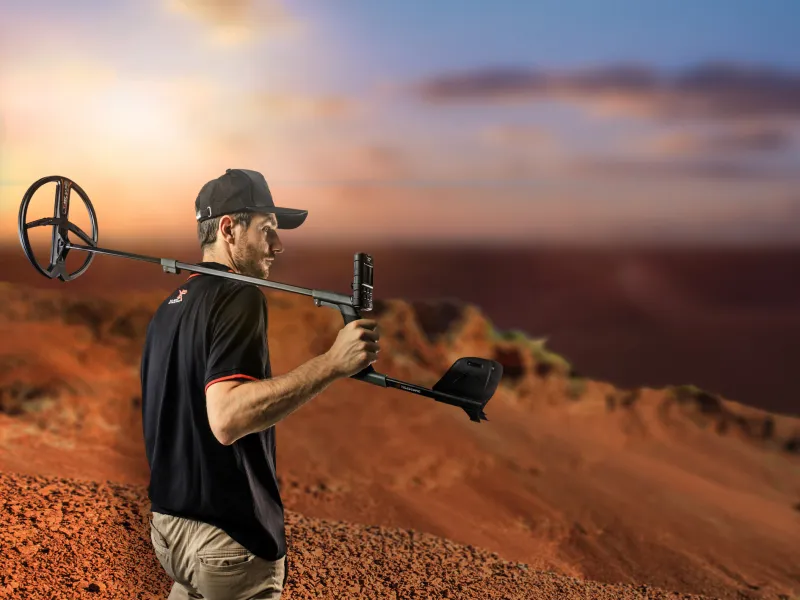
XP XTREM Hunter XTR-115 deep-seeking detector for large objects
XP XTREM Hunter XTR-115 – deep-seeking detector based on the DEUS II as a complete set
The world's first FMF® twin-box system with wireless DEUS II operation, no-motion detection down to 5 m and iron discrimination – carried in one hand
The XP XTREM Hunter XTR-115 is a different kind of deep-seeking detector: not a classic two-box detector with its own electronics, but a modular system built entirely on the proven DEUS II platform. The two large FMF® coils (30 × 45 cm) replace the normal search coil – the remote control stays the same, the principle remains familiar. What really sets the XTR-115 apart is the combination of simultaneous multi-frequency technology (FMF®, 49 single frequencies from 4–45 kHz), true wireless operation and a remarkably low weight for a deep-seeking detector of 2.9 kg – including the remote control. The device detects large metal masses down to 5 m, is the only system on the market to offer iron discrimination at two-box level and can be converted into a fully-fledged DEUS II detector in seconds. The complete set contains everything you need for immediate use in the field. At a price of €2,499, the XTR-115 is clearly a professional investment – but one that is justified by its versatility and future-proofing.

Overview & manufacturer
XP Metal Detectors is a French company based in Castanet-Tolosan near Toulouse and one of the most technologically advanced detector manufacturers in Europe. XP became known for the wireless DEUS – a detector that revolutionised the segment more than a decade ago with its modular, battery-powered concept. Its successor, the DEUS II with FMF® multi-frequency technology, is also the technical basis of the XTR-115.
XP is one of the first companies to have been awarded the European Longtime® label – a certificate for sustainably designed products with guaranteed repairability for at least 10 years after the date of purchase and a 5-year manufacturer's warranty. For a professional tool in this price class, that is a relevant factor.
The XTREM Hunter XTR-115 is the brand's first deep-seeking detector and at the same time a novelty in the two-box segment: for the first time, a deep detection system combines simultaneous multi-frequency signal processing (FMF®) with complete wireless operation and seamless compatibility with a modern search detector system.
What's in the box – complete set
The complete set includes everything you need for immediate use in the field. If you already own an XP DEUS II RC, you can choose the cheaper add-on set instead.
| Component | Details |
|---|---|
| Deep-seeking coils | XTR115TX (transmitter) + XTR115RX (receiver), each 30 × 45 cm FMF® Double-D coils |
| remote control | XP DEUS II RC (software version 2.0 required) |
| Display protector | XP protective glass for the DEUS II remote control |
| Wireless headphones | XP WSA XL ST (over-ear, wireless, weather-resistant – not waterproof) |
| Shaft | XTR-specific S telescopic shaft, height-adjustable, can be dismantled |
| Charging equipment | Accessory set with mains charger, USB-C charging cable |
| Carry case | XTR hard-shell case, rain- and shock-proof (725 × 480 × 170 mm) |
| Documentation | User manual available in German and English (PDF download) |
| Warranty | 2-year statutory warranty + 3-year additional manufacturer's guarantee |
If you already own a DEUS II RC, you can also buy the XTR-115 as a pure add-on set (without remote control and headphones). This saves a considerable amount and is the most sensible option for existing DEUS II users.
Technical data
| Property | Value |
|---|---|
| Principle | Two-box locator (twin box), no-motion deep detection |
| Technology | FMF® – Fast simultaneous Multi Frequency (XP patent) |
| Frequency range | 49 single frequencies simultaneously, 4–45 kHz |
| Coils | XTR115TX + XTR115RX, 30 × 45 cm Double-D FMF® coils |
| Detection depth | Up to 5 m (with sufficiently large metal objects) |
| Discrimination | Iron / non-ferrous (limited with very large masses) |
| Total weight | 2.9 kg (incl. DEUS II remote control) |
| Case weight | 5.8 kg (incl. case) |
| Assembled length | 1.2 m |
| Case dimensions | 725 × 480 × 170 mm |
| Battery | Li-Ion 18650, 1×, 11 Wh, 45 g |
| Battery life | > 10 hours (depending on audio setting) |
| Charging time | approx. 4 hours (USB-C) |
| Headphone compatibility | WSA XL ST, WSA ST, WS6 ST, XP bone conduction headphones |
| Connection speed | 10× faster than Bluetooth (XP's own protocol) |
| Operating temperature | 0 – 40°C |
| Robustness | Weather-resistant & shock-proof |
| Software | Updatable via the DEUS II RC (USB system) |
| Manufacturer | XP Metal Detectors, Castanet-Tolosan, France |
| Warranty | 5 years in total (2 + 3) |
FMF® technology – what's behind it?
FMF stands for Fast simultaneous Multi Frequency and is a signal processing method patented by XP that transmits and evaluates 49 single frequencies between 4 and 45 kHz at the same time. Unlike conventional two-box systems, which usually work with a single low frequency, the XTR-115 constantly calculates an evaluation result from the entire frequency spectrum. This considerably reduces ground noise and allows a much quieter signal – even in heavily mineralised ground.
Technically, the XTR-115 system is paired with the DEUS II remote control via its serial number, just like an ordinary search coil. As soon as the connection is established, the display automatically switches to the XTREM Hunter's specific deep-seeking menus – with its own display values, sensitivity levels and audio programs. The system can be switched back to a normal FMF search coil in seconds, without tools and without a restart.
The XTR-115 is not an all-rounder. It only detects larger metal masses. Small objects such as nails, coins or button cells are physically not picked up by the system – this is intentional in the design and not a fault. Its strength lies in detecting larger objects at depths that are out of reach for normal search detectors.
The iron discrimination of the XTR-115 is a real innovation in the two-box segment: until now, users of classic deep-seeking detectors had to dig blind. The XTREM Hunter can distinguish medium-sized ferrous objects from non-ferrous ones – not with the precision of a high-quality VLF detector, but well enough to rule out obvious iron finds when in doubt. The reliability of this discrimination decreases as the object mass increases, as XP itself states objectively.
No-motion operation – how is the device used?
Anyone working with a two-box locator for the first time needs some time to get used to it: the XTR-115 does not need to be swept . The device works in no-motion mode – meaning you move it slowly over the search area and hold it still briefly when a signal occurs. The signal strength increases as you approach the target object, allowing rough localisation. For precise pinpointing, it is then recommended to switch to a normal search coil and search the area in a targeted way.
The detection field builds up entirely below the two coils. Towards the user, the field is largely shielded – but when using it, make sure you are not carrying any metal objects on your body: mobile phones, keys, belt buckles, shoes with metal inserts and the like can distort the result. XP recommends checking your own equipment with a pinpointer before every search – especially outdoor shoes, which often contain a thin metal plate in the sole.
Headphones should always be used for perfect target recognition – the WSA XL ST included in the complete set is ideal for this. The nuances in the audio signal are decisive for assessing the target, especially with iron discrimination.
Seamless DEUS II integration – the modular system in practice
The most convincing argument for the XTR-115 is not the pure depth performance – but the way it is embedded in the XP ecosystem. Other two-box systems are stand-alone devices with a separate control unit, their own battery and their own learning curve. The XTREM Hunter, on the other hand, behaves like a large coil – with all the advantages that brings:
Coil change in seconds
Once you have roughly located the target, switch to a normal FMF coil (22.5 cm, 28 cm or 28×34 cm) and pinpoint the signal precisely with the familiar DEUS II interface. No conversion, no tools.
Familiar user interface
Existing DEUS II users do not have to learn any new software. When the XTR-115 is connected, the RC automatically shows the deep-seeking menus and display values.
Updatability
Firmware updates are installed via the familiar DEUS II USB updater. XP supports its devices with software updates for many years – a clear advantage over closed competitor solutions.
The wireless headphone connection runs on XP's own radio protocol – which, according to the manufacturer, is 10 times faster than Bluetooth and therefore works practically without latency. For deep-seeking detectors that transmit subtle signal changes, this is a real argument.
Areas of use
The XTR-115 is not a detector for the everyday detectorist. It was developed for situations in which large objects are searched for at great depths – and in which a normal detector simply cannot go any further.
Archaeology
Discovering large artefacts, preliminary site surveys and depth mapping. The device is suitable for authorised archaeological preliminary investigations in which depth is more important than precision on small objects.
Explosive ordnance disposal
Locating deep-lying metallic ordnance in preliminary site investigations. XP explicitly also developed the device for professional security tasks.
Treasure and relic hunting
Locating hidden hoards, large treasures or historically relevant accumulations of metal at depths that remain out of reach for conventional detectors.
Industry & infrastructure
Locating buried tanks, pipes, valve covers and other large metal structures in civil engineering.
Ergonomics & transport
With a total weight of 2.9 kg with the remote control fitted, the XTR-115 is exceptionally light for a deep-seeking detector of this class. Classic two-box systems such as the Fisher Gemini-3 or the Garrett TreasureHound are heavier, more unwieldy constructions that require body harnesses for longer use. The XTR-115 is designed for one-person operation and can be individually balanced via the adjustable handle.
The height-adjustable S telescopic shaft can be completely dismantled. Taken apart into its individual components, the entire system fits into the supplied hard-shell case (725 × 480 × 170 mm, total weight 5.8 kg). If you are often on foot, you can choose the optional XP BP280 backpack as an alternative. The assembled length of 1.2 m is adapted to average body heights, but the handle can be moved to adjust the balance for taller or shorter people.
According to XP, the XTREM Hunter is weather-resistant and shock-proof. Rain, dew and dirt do the device no harm. The coils themselves are not designed for underwater use – unlike the normal FMF search coils, which are waterproof to a diving depth of 20 m.
Strengths & limitations
The XTR-115 is a very specialised device. Anyone who understands what a two-box locator can and cannot do will be very satisfied with the XTREM Hunter. Anyone looking for an all-round device is badly advised.
- ✓World's first FMF® two-box system – simultaneous multi-frequency for deep detection as a real advantage over single-frequency competitors
- ✓Iron discrimination at two-box level – a so far unique feature in the deep-seeking segment
- ✓Full DEUS II compatibility – no new system to learn, no second control unit
- ✓Switch between the deep-seeking coil and a normal FMF search coil in seconds
- ✓Only 2.9 kg total weight – one-person operation possible without a body harness
- ✓Wireless connection (RC + headphones) without latency, 10× faster than Bluetooth
- ✓Updatable – XP's long-term software support is well known and proven
- ✓5-year warranty (Longtime® programme) – above average for this class
- ✓Compact hard-shell case included – ready for field use immediately
- –No detection of small targets – coins, nails, jewellery and other small objects are not picked up by design
- –Price €2,499 – a considerable investment that only pays off with regular use for deep searching
- –DEUS II RC absolutely required (software V2.0) – no operation without a working remote control
- –Iron discrimination becomes less reliable with very large masses
- –No underwater coils – use only in weather-resistant conditions, not submersible
- –No metal may be carried on the body – requires deliberate preparation before every use
Available set versions at a glance
The XTREM Hunter is available in three configurations. Depending on the equipment you already have, you can get started or expand in a targeted way.
Coils only (add-on)
XTR-115 coils + shaft + case – without RC and headphones. Ideal for existing DEUS II users. The cheapest way into the deep-seeking system.
Complete set (this version)
Complete set incl. DEUS II RC, WSA XL ST headphones, case & accessories. Ready for immediate use, no further purchases needed. €2,499.
Bundle with DEUS II
XTR-115 + complete DEUS II (with FMF coil) as a combination bundle. The greatest range of functions for anyone buying both from scratch.
Market classification
There are few directly comparable products in the deep-seeking segment. Classic two-box systems such as the Fisher Gemini-3 or the Garrett TreasureHound EX work with analogue single-frequency technology and have neither a wireless user interface nor iron discrimination. They cost between €500 and €900, but thanks to their simpler signal processing still offer solid performance in some scenarios for newcomers to deep searching.
In the FMF multi-frequency segment, the XTR-115 is currently without competition. No other manufacturer offers a two-box deep-seeking system with simultaneous multi-frequency technology, wireless operation and true system integration into a modern search detector. Anyone who has already invested in the XP ecosystem will find the XTR-115 a logical addition that greatly enhances their own equipment.
| Model | Technology | Discrimination | Wireless | Depth |
|---|---|---|---|---|
| XP XTREM Hunter XTR-115 | FMF® (49 freq., 4–45 kHz) | Iron/NF (limited) | Yes (DEUS II) | to 5 m |
| Fisher Gemini-3 | Analogue, 1 freq. | No | No | to 4–5 m |
| Garrett TreasureHound EX | Analogue, 1 freq. | No | No | to 4 m |
| Nokta Makro Jeohunter 3D | 3D imaging, PI | 3D map (visual) | No | to 3 m (active) |
Rating in detail
| Criterion | Rating | Comment |
|---|---|---|
| Detection depth | ★★★★★ | Up to 5 m with sufficiently large metal objects – outstanding in the two-box segment |
| FMF® technology | ★★★★★ | Unique in this device category; much quieter signal than single-frequency competitors |
| Iron discrimination | ★★★★★ | Unique in the two-box segment; less reliable with very large masses |
| DEUS II integration | ★★★★★ | Seamless switching, familiar user interface, no separate system needed |
| Ergonomics & weight | ★★★★★ | 2.9 kg is exceptionally low for a deep-seeking detector of this class |
| Portability | ★★★★★ | Compact hard-shell case, dismantlable shaft, optional backpack available |
| Battery life | ★★★★★ | > 10 hours, practical for all-day use; not replaceable in the field |
| Build quality & robustness | ★★★★★ | Weather-resistant, shock-proof, high-quality materials typical of XP; Longtime® label confirmed |
| Best value | ★★★★★ | Justified for a specialist deep-search detectorist; too expensive for occasional users |
| Scope of delivery | ★★★★★ | RC, WSA XL ST headphones, case, charger – a complete ready-to-go set with no extra purchases |
| Documentation | ★★★★★ | German and English manual available; PDF directly accessible |
Conclusion
The XP XTREM Hunter XTR-115 closes a gap that has long existed in the deep-seeking market: a modern, light, wireless two-box system with multi-frequency technology and true system integration. What used to mean two separate devices – search detector and two-box locator – with two learning curves, two batteries and two cases has grown together with the XTR-115 into a single, handy complete set.
The advantage for existing DEUS II users is obvious: the system is paired like a new coil, the user interface remains familiar, and switching between deep searching and normal searching takes seconds. This is not just convenient – it is real practical added value in the field when you locate a first signal with the XTR-115 and then pinpoint it precisely with a small FMF coil.
Who is the XTR-115 the right choice for? For serious detectorists who regularly work in areas where conventional detectors reach their limits. For archaeologists, explosive ordnance disposal teams and treasure hunters who are after large objects lying deep. And for DEUS II owners who want to expand their existing system sensibly and without much extra effort.
Anyone looking for an entry-level detector or an all-round device for coins and jewellery, on the other hand, is badly advised – the XTR-115 is neither designed nor suitable for that.
A technological milestone in the two-box segment. Points deducted mainly because of the high entry price. Anyone in the target group gets the most innovative deep-seeking system currently on the market.
Latest reviews & guides
Expert knowledge about metal detectors
Contact
Metalldetektoren.de
Andreas Licht
Professor-Derra Str. 3
96465 Neustadt b. Coburg
Germany
Our service
Information
- Delivery time
- Payment & shipping
- My quick purchase
- Privacy and data protection
- Authenticity of customer reviews
- Terms and conditions
- Battery Act notice
- Cookie settings
Our brands