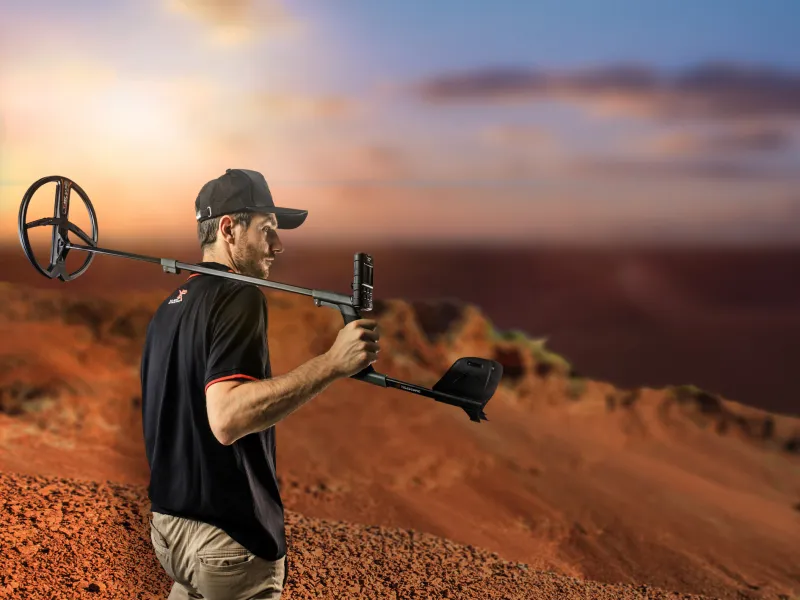
Minelab Manticore metal detector – review, price & depth
Minelab Manticore – high-end multi-frequency metal detector
Multi-IQ+ simultaneous multi-frequency, 2D target identification map, 10 search modes & fully submersible to 5 m
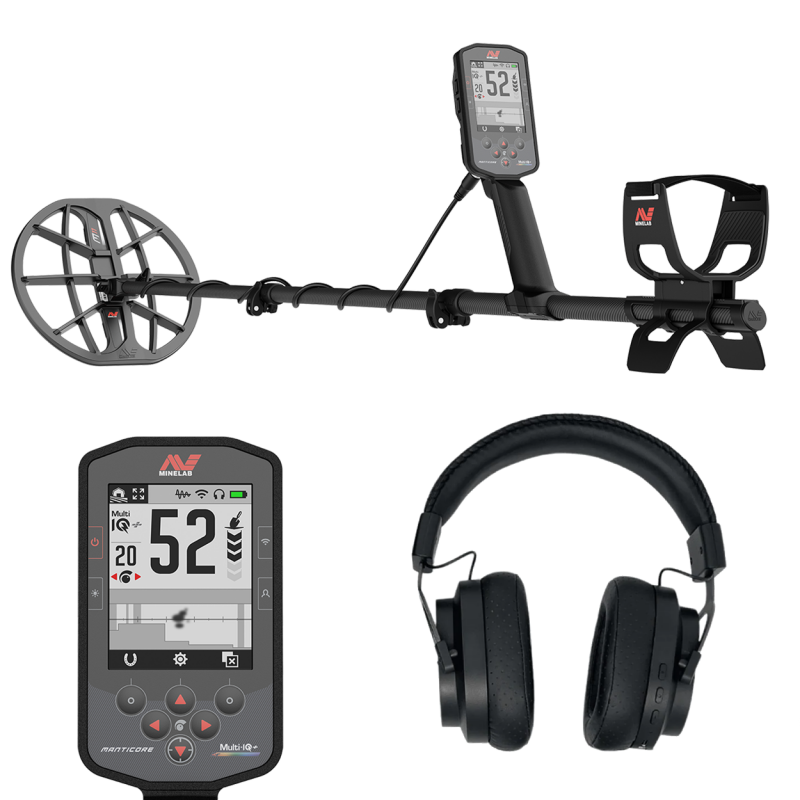
The Minelab Manticore is the current flagship of the Australian manufacturer Minelab and thus the most powerful simultaneous multi-frequency machine the company has ever built. At its heart is the further developed Multi-IQ+ engine, which according to Minelab provides 50 per cent more transmit power than the Equinox series. Its most outstanding feature compared with all competitors is the 2D target identification map: it displays detected objects on a colour screen simultaneously by conductivity (horizontal) and ferrous content (vertical) – a depth of visualisation not worked out to this degree on any other detector in this class. With ten customisable search modes, extensive audio options, handle vibration, a built-in flashlight and a fully waterproof carbon fibre design down to 5 m, the Manticore is consistently aimed at professional use. The price of 1,999 euros reflects this position unmistakably.
1. Overview – Minelab and the Manticore
Minelab Electronics is an Australian manufacturer headquartered in Mawson Lakes near Adelaide that has been one of the technological pioneers in metal detecting for decades. With the Equinox, the company made simultaneous multi-frequency technology accessible to a wide audience, and with the CTX 3030 it introduced a two-dimensional target display into the hobby segment early on. The Manticore combines both lines of development and takes them to a new level: faster engine, more transmit power, revised signal processing and a much further developed 2D target display.
Internally the detector carries the model number 3228-0200. In the Minelab range, the Manticore is the top model for coin and treasure hunting; only the gold specialists GPX 6000 and GPZ 7000 rank above it in the overall hierarchy – but they are specialised purely in gold prospecting in mineralised ground. For detectorists hunting coins, jewellery and relics on historical sites, in parks, fields, on beaches and under water, the Manticore is Minelab's most technically mature detector.
2. What's in the box
| Component | Details |
|---|---|
| Minelab Manticore | Control unit with large colour LCD, built-in speaker, flashlight, handle vibration and magnetic USB charging connector |
| M11 search coil (28 cm, round) | Double-D coil, fully waterproof (IP68) to 5 m, incl. coil cover; all-round coil for all types of terrain |
| ML-105 wireless headphones | Wireless low-latency headphones with Minelab's proprietary wireless protocol; not waterproof |
| Carbon fibre telescopic shaft | 3-piece, folds compactly; extended 144 cm / collapsed 63 cm; adjustable armrest |
| 3.5 mm headphone cable | For wired headphones on the waterproof 3.5 mm socket (with protective flap) |
| USB charging cable | Magnetic snap-on charging plug; compatible with Windows and macOS for firmware updates |
| 5× screen protectors | To protect the large colour LCD panel |
| Headphone bag | Protective bag for the ML-105 headphones |
No pinpointer and no carrying case included. The supplied ML-105 headphones are not waterproof – for underwater use you need the handle vibration or separate waterproof wired headphones (via the 3.5 mm socket). Optionally available are the M9 (23 cm, elliptical) and M15 (38 × 30 cm, large) search coils and the Minelab Pro-Find 40 pinpointer.
3. Technical data
| Feature | Value / description |
|---|---|
| Technology | Multi-IQ+ – simultaneous multi-frequency (Minelab's own development, further development of Multi-IQ) |
| Operating frequencies | Multi-IQ+ (simultaneous multi-frequency), 5 kHz, 10 kHz, 15 kHz, 20 kHz, 40 kHz (single frequencies selectable) |
| Search modes | 10 customisable modes: 5× All-Terrain, 4× Beach, 1× Goldfield |
| Target IDs | 0–99 (non-ferrous); 0–99 red (ferrous) – two-dimensional display on the 2D ID map |
| 2D target identification | Graphic 2D ID map: horizontal axis = conductivity (0–99), vertical axis = ferrous content (FE-CO display) |
| Sensitivity | 1–35 levels |
| Recovery speed | 0–8 levels (recovery speed) |
| Iron limits | Upper iron limit: 0–14; lower iron limit: 0–9; user-definable 1–4 |
| Audio tones | 1, 2, 5 tones (bit tones) or region tones; audio modes: Normal, Enhanced, Continuous Pitch (VCO) |
| Volume | Target volume 0–25; iron volume 0–25; threshold 0–25; pitch 1–50 |
| Volume profiles | Simple, Medium, Rich (three overall volume profiles) |
| Ground balance | Automatic, manual, continuous tracking |
| Noise cancel (EMI) | Auto, continuous auto, manual (–9 to +9) |
| Depth indicator | 5 levels |
| Pinpoint | Yes, dedicated button |
| Lighting | Display (10 levels manual or automatic), backlit keypad, built-in flashlight, coil light (M11) |
| Vibration | Integrated in the handle – ideal for underwater searching or noisy environments |
| Audio outputs | Built-in speaker; 3.5 mm headphone socket (waterproof with protective cap); wireless low-latency transmission (ML-105) |
| Battery | Integrated Li-ion battery; runtime approx. 10 hours; charging time approx. 7 hours |
| Charging | Magnetic USB charging connector (proprietary) |
| Firmware updates | Via USB cable, Windows and macOS compatible |
| Waterproofing | IP68, fully to 5 m (control unit + M11 search coil); ML-105 headphones not waterproof |
| Shaft length | 63 cm (collapsed) to 144 cm (extended) |
| Weight | Ca. 1.3 kg |
| Origin | Minelab Electronics Pty Ltd, Mawson Lakes, Australia; EU contact: Minelab International Ltd, Cork, Ireland |
4. Multi-IQ+: the multi-frequency technology in detail
Multi-IQ+ is Minelab's current generation of simultaneous multi-frequency technology and the direct further development of Multi-IQ, which was already used in the Equinox. The decisive differences from its predecessor lie in three areas: higher transmit power, a wider frequency range and completely revised digital signal processing.
More transmit power, wider spectrum
According to the manufacturer, Multi-IQ+ transmits 50 per cent more energy through the search coil than the Equinox engine, and does so over an extended frequency range. The result is higher signal strength on weak or deep targets. In practice this shows up as a cleaner, more repeatable signal response even on objects at the very limit of detectability – a difference that experienced detectorists often confirm in direct comparisons between the Manticore and Equinox 900.
Revised signal processing
The redesigned processing shows above all in target ID stability: the Manticore shows more stable target IDs for the same object across the entire width of the sweep than the Equinox. This simplifies the identification decision, especially on heavily mineralised ground or at the border between ferrous and non-ferrous. The recovery speed can be set in eight levels, allowing fine-tuning between maximum separation of closely spaced targets and the greatest sensitivity to weak signals.
Five single frequencies as an alternative
In addition to the simultaneous Multi-IQ+ mode, the single frequencies 5, 10, 15, 20 and 40 kHz are available. Low frequencies (5 kHz) are suitable for deep, large targets and ground with little mineralisation; high frequencies (20, 40 kHz) for small coins, gold jewellery and gold nuggets. Being able to switch to a single frequency when needed allows targeted adaptation to special search conditions without having to use a different detector.
The Equinox used a wider frequency range than classic single-frequency detectors, but worked with lower transmit power. Multi-IQ+ increases this power significantly and improves the processing architecture, which now provides more computing capacity for the 2D ID evaluation. The Manticore's target ID range runs from 0 to 99 (compared with 0 to 40 on the Equinox), enabling finer differentiation – especially in the middle of the ID range.
5. The 2D target identification map – the unique feature
The Manticore's most striking technical feature is the two-dimensional target identification map. While conventional detectors show a detected object as a single number (target ID) on the display, the Manticore's 2D ID map shows each signal as a graphic point in a two-dimensional coordinate system.
How the 2D ID map works
The horizontal axis represents the conductivity of the detected object (0–99): on the left are poorly conductive materials such as small iron parts or aluminium foil, on the right highly conductive materials such as silver or copper. The vertical axis shows the ferrous value of the signal. Non-ferrous targets appear along the centre line or below it; iron moves upwards. Small iron parts show at the top, larger ferrous objects further down.
Every detected signal leaves a trace – a dot or a mark – whose brightness and size depend on the signal strength. Signal strength, size and depth of the object can thus be read intuitively before the first spadeful is dug. Mixed signals, such as a non-ferrous object right next to a nail, produce characteristic trace patterns that differ from clean single targets – a real gain in information compared with the classic target ID display.
Adjustable iron limits
On the 2D map, iron limits can be set as a visual dividing line. Targets above the line are classified as iron and can be muted by discrimination; targets below are treated as non-ferrous. This dividing line can be adjusted in steps: if you want to unmask as many targets as possible, choose a high limit setting; if you want to filter iron aggressively on clean ground, set the limit lower. This gives the detectorist a level of control that goes far beyond what a simple discrimination display offers.
On sites heavily littered with junk – castle slopes, medieval settlements, old camp sites – the 2D display is a clear advantage. Targets that show a similar target ID on a classic detector (e.g. a silver-plated brooch and a bottle cap) can be differentiated on the 2D map by their different ferrous signatures. On meadows with little junk and no iron problem, the added value is less pronounced – there the classic target ID is often enough.
6. Search modes – ten customisable programs
The Manticore offers ten factory-configured search modes divided into three groups. Each mode is fully customisable: sensitivity, recovery speed, audio profile, iron limits and discrimination pattern can be saved separately for each mode. A user-configurable soft key gives direct access to a freely assignable function.
All-Terrain (5 modes)
For parks, fields, woods and historical sites. Different presets for different ground mineralisation, amounts of junk and target sizes – from coin hunting on park lawns to relic hunting in ploughed fields.
Beach (4 modes)
Optimised for dry sand, wet beach sand, surf and salt water. Four separate beach programs take into account the different conductivity and mineralisation of these environments. Fully submersible to 5 m.
Goldfield (1 mode)
For hunting gold nuggets in mineralised ground. Emphasises high frequency components and increased sensitivity to small, weakly conductive objects. Suitable for historical gold mining areas and mineralised mining landscapes.
Unlike many professional detectors, the Manticore's factory settings are tuned so that they deliver good results even without in-depth familiarisation. Several user reports confirm that the Manticore achieves competitive find rates straight out of the box without fine-tuning. The many settings are intended as a tool for experienced detectorists, not as a compulsory programme for everyone.
7. Audio system and headphones
The Manticore's audio system offers a depth of configuration that is usual in this class of detector, but well thought out in the details. In addition to the classic tone options (1, 2 or 5 tones), there are three basic audio modes:
Normal
Classic discrete tone output as on the Equinox 800 – familiar to anyone switching from the Equinox series. Clear, direct, well suited to structured search routines.
Enhanced
More nuanced tone output with more audible information per signal. Differences in depth, size and type of object become more clearly audible. Recommended for experienced detectorists.
Continuous Pitch (VCO)
Pitch varies continuously with signal strength – the closer the object, the higher the tone. Classic VCO behaviour as in the all-metal modes of older detectors. Good for maximum depth information through audio feedback.
Target volume, iron volume, threshold and pitch can each be adjusted separately – a flexibility that helps on heavily junk-littered sites to pick relevant signals out of the background noise. Three volume profiles (Simple, Medium, Rich) allow quick overall adjustment without touching individual parameters.
ML-105 wireless headphones
The supplied ML-105 transmits audio via Minelab's proprietary low-latency wireless protocol. According to user experience, the latency is noticeably lower than standard Bluetooth, which matters when swinging fast. The headphones are light and comfortable to wear, but not waterproof – for underwater use you have to switch to the handle vibration or wired headphones via the 3.5 mm socket.
The vibration integrated into the handle is particularly practical for underwater searching: headphones off, submerge the detector, rely on the vibration. This allows more comfortable underwater searching without depending on audio signals. In noisy environments (wind, surf) the vibration is also a useful addition to the audio.
8. Search coils – M11 and the optional coil range
The Manticore comes with the M11 double-D search coil (28 cm, round). It is fully waterproof (IP68) to 5 m, has its own light and is considered a well-balanced all-round coil for most applications. Minelab offers two optional coils that extend the range of applications:
M11 – 28 cm, round ← included
Universal all-round coil. Good balance between depth, coverage and separation. Suitable for almost all applications from parks to the beach and under water.
M9 – 23 cm, elliptical (optional)
The lightest Manticore coil (approx. 362 g). Especially for heavily junk-littered ground with lots of iron, small objects and tight areas. Thanks to its flat shape, also well suited to underwater use – less drag in currents.
M15 – 38 × 30 cm, elliptical (optional)
Deep-seeking coil for maximum coverage on open ground. Clear depth gains on large targets. Recommended for large fields and hunting deeper relics.
All three Manticore coils (M9, M11, M15) are compatible exclusively with the Manticore – they fit neither the Equinox nor other Minelab models. If you already own Equinox coils, you cannot continue using them. The Manticore's coil range is currently smaller than that of other high-end systems, but fully sufficient for most scenarios.
9. Ergonomics, shaft and build quality
With a total weight of approx. 1.3 kg, the Manticore is mid-field in the high-end segment. The three-piece carbon fibre shaft is compact, stable and extends from 63 cm to 144 cm. The adjustable armrest and ergonomically shaped grip provide a comfortable hold even on long outings.
The Manticore's large colour LCD panel is one of the most legible displays in the comparison field. Minelab has balanced size, contrast and information density well: target ID, 2D ID map, search mode, sensitivity, battery level and status symbols can be read without familiarisation. The display brightness can be adjusted manually in ten levels or set to adapt automatically to the surroundings.
Further comfort features in the field: a built-in flashlight on the control unit for working at dusk or in dark trenches, a backlit keypad and the handle vibration already mentioned. Charging is via a magnetic connector that clicks into place without precise alignment – a small but practical detail in everyday use.
One point occasionally mentioned in user reports: the cable between control unit and search coil runs along the outside of the shaft – not inside as on the CTX 3030. This is a design decision that reduces weight, but is occasionally found annoying on the shaft. In practice it is a marginal issue that does not noticeably affect everyday searching.
10. In the field – strengths and limitations
- 2D target identification map: graphic ferrous/non-ferrous differentiation unique in this class
- Multi-IQ+ with 50 % more transmit power than the Equinox – measurably better depth on weak signals
- Stable target IDs across the whole sweep – more reliable identification decisions
- 10 fully customisable search modes for all types of terrain and targets
- Adjustable iron limits for maximum control over discrimination behaviour
- Extensive audio options: 3 audio modes, 5 tone regions, separately adjustable iron and target volume
- Large, easy-to-read colour LCD with automatic brightness adjustment
- Built-in flashlight, backlit keypad, handle vibration – fully suitable for use at night
- IP68 to 5 m – control unit and M11 coil fully submersible
- Ready to go out of the box: standard programs deliver very good results even without fine-tuning
- Active firmware support by Minelab – free updates via USB
- Price: EUR 1,999 – the highest barrier to entry in the direct comparison field
- ML-105 headphones not waterproof – for underwater use only vibration or wired headphones
- Firmware updates only via USB cable on a PC or Mac – no wireless update as on the Nokta Legend 2
- No pinpointer included
- Coil cable routed along the outside of the shaft – not inside as on the CTX 3030
- Small coil range (3 coils) compared with the XP DEUS II
- Battery life approx. 10 hours – charging time approx. 7 hours; for very long days in the field a spare charger is recommended
- Unlocking the full potential of the 2D map and the audio configuration takes experience
11. Market positioning
At 1,999 euros, the Minelab Manticore is the most expensive detector in the direct comparison field for coin and treasure hunting. Its closest in-house competitor, the Minelab Equinox 900, costs around 500 euros less and also offers simultaneous multi-frequency, but without the 2D ID map and with lower transmit power. The difference is real and clearly noticeable in demanding situations – mineralised ground, densely populated sites, heavily junk-littered areas.
Compared with the XP DEUS II (from approx. EUR 1,300–1,600 depending on configuration), the Manticore positions itself with its 2D ID map and larger display as the alternative with more visual information; the DEUS II scores with its fully wireless system, more extensive coil range, much lighter weight and true stereo audio system. Both are on a similar technical level – the preference depends on whether you value visual target information (Manticore) or audible depth and maximum freedom of movement (DEUS II).
Compared with the Nokta Legend 2 (EUR 1,099), the Manticore offers 2D target identification, higher transmit power and the more mature coil range – the Legend 2, on the other hand, is cheaper, lighter, comes with two search coils as standard and allows wireless firmware updates. For many detectorists, the price difference of 900 euros will be the decisive question.
12. Rating
| Criterion | Score | Comment |
|---|---|---|
| Detection performance | ★★★★★ | Multi-IQ+ with 50 % more power than the Equinox – best depth in the coin hunting segment |
| 2D target identification | ★★★★★ | Unique feature in this segment; graphic ferrous/non-ferrous differentiation |
| Frequency flexibility | ★★★★★ | Multi-IQ+ + 5 single frequencies; good, but narrower than the 49 steps of the DEUS II |
| Ergonomics / weight | ★★★★★ | 1.3 kg, well balanced; cable on the outside of the shaft is a small minus |
| Ease of use | ★★★★★ | Large display, intuitive keypad, ready to go without a long learning period |
| Audio system | ★★★★★ | 3 audio modes, 5 tone regions, separately adjustable – excellent configuration depth |
| Battery life | ★★★★★ | Approx. 10 h runtime; 7 h charging time is long by comparison |
| Waterproofing | ★★★★★ | IP68 to 5 m – control unit and M11 coil fully submersible |
| Scope of delivery | ★★★★★ | Only one search coil; headphones not waterproof; no pinpointer |
| Best value | ★★★★★ | EUR 1,999 is a lot – the technology justifies it, but the gap to alternatives is noticeable |
| Build quality | ★★★★★ | Carbon fibre shaft, robust housing, high-quality colour LCD – premium level |
13. Conclusion
The Minelab Manticore is the most powerful simultaneous multi-frequency detector Minelab has ever built for coin and treasure hunting. The combination of the further developed Multi-IQ+ engine and the 2D target identification map results in a system that no other manufacturer has implemented so consistently in this form. If you work on heavily junk-littered sites, hunt weak signals on mineralised ground or simply want the maximum visual information before digging, the Manticore is the most technically mature instrument on the market.
The factory settings are tuned so well that the Manticore delivers good results right from the start, even for detectorists without in-depth experience. That cannot be taken for granted for a professional detector of this complexity. Those who then explore the settings step by step – iron limits, audio configuration, interpreting the 2D map – will find that the learning curve pays off continuously in the long run.
The price of 1,999 euros is the only real limitation: it is higher than the XP DEUS II in many configurations and almost twice that of the Nokta Legend 2. If you can and want to invest this amount, you get the most technically sophisticated high-performance all-rounder in the coin hunting segment. If you are looking for a functionally strong multi-frequency detector with very good value for money, the Equinox 900, Legend 2 or DEUS II will also serve you excellently.
Latest reviews & guides
Expert knowledge about metal detectors
Contact
Metalldetektoren.de
Andreas Licht
Professor-Derra Str. 3
96465 Neustadt b. Coburg
Germany
Our service
Information
- Delivery time
- Payment & shipping
- My quick purchase
- Privacy and data protection
- Authenticity of customer reviews
- Terms and conditions
- Battery Act notice
- Cookie settings
Our brands