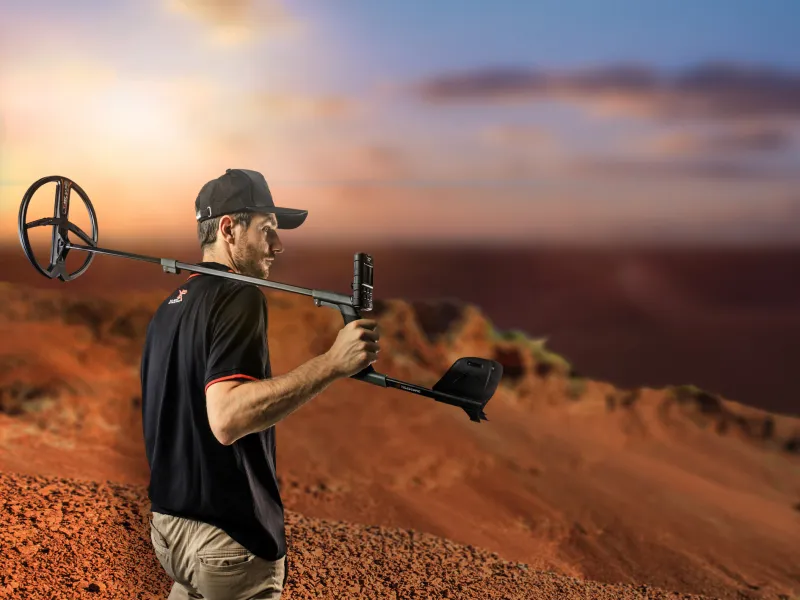
XP DEUS II HF2 – the elliptical high-frequency FMF coil
XP DEUS II HF2 – the elliptical high-frequency FMF coil field-tested
Up to 120 kHz single frequency, elliptical design, three times the battery capacity – the HF2 is not simply a new coil. It opens up a completely different hunting ground.
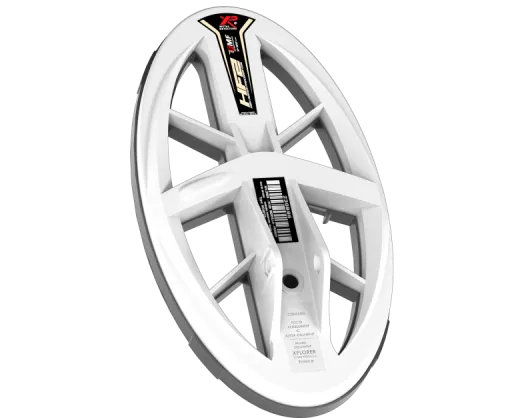
The XP DEUS II HF2 is the first search coil to combine FMF® multi-frequency technology with true high frequencies (up to 90 kHz in FMF mode, up to 120 kHz in single-frequency mode). The elliptical design (24 × 13 cm) is no coincidence – it is the key: narrower, more precise, more agile. Anyone who has already worked their search areas with standard FMF coils, or who regularly searches in heavily trashy, overgrown or densely built-up areas, will find targets with the HF2 that they have walked past until now. This comes at a price – both financially and in terms of the learning curve. But as a complement to the 22 or 28 cm standard coil, it is probably the most precise tool XP has built for the DEUS II so far.
Why an HF2? The gap in the DEUS II coil range
When the DEUS II came onto the market in 2021, there were three FMF® coils: 22 cm round for separation and weight, 28 cm round as an all-rounder and later the 28 × 34 cm for maximum depth. All three share the same FMF® frequency bandwidth of 4–45 kHz – a broad, stable foundation for most situations.
But in one area the coil family left a gap: the tiniest objects on difficult ground. Gold chains with 0.5 mm wire. Thin ancient coins with low conductivity. Tiny gold nuggets. Targets where depth matters less than filtering out a weak, high-frequency signal from heavily mineralised or electrically disturbed environments. This is exactly the gap the HF2 fills.
XP had already offered HF coils with up to 81 kHz for the Deus 1 and the ORX – and both were regarded there as an insider tip for specialists. The HF2 for the DEUS II goes much further: it combines the high frequencies with FMF® multi-frequency mode and a completely new battery architecture that covers the higher energy demand of the high-power design.
Technology in detail – what really makes the HF2 different
Three frequency ranges instead of one
The HF2 was developed around three well-defined main frequency ranges, which are used simultaneously in FMF® mode: 9–27 kHz, 17–53 kHz and 17–90 kHz. Each of these ranges can also be shifted in seven steps – giving 21 different FMF® frequency bands. In single-frequency mode, 49 selectable frequencies from 9 to 120 kHz are available. This wide frequency coverage makes the HF2 unique in the DEUS II ecosystem.
High-power design – an ellipse with a boosted signal
Elliptical coils naturally lose some depth compared with round coils of the same area – this is physically unavoidable. XP has compensated for this disadvantage with a deliberate high-power design: the HF2 works with more electrical energy than older coil models and drives the signal into the ground more aggressively. This is why the 2,300 mAh battery is around three times the size of earlier XP HF coils.
The new battery: replaceable in the lower shaft, USB-C directly on the pack
The lithium battery sits in the coil's carbon lower shaft – not in the coil itself. This has two advantages: if the battery runs low after long sessions, it can be swapped within seconds for an optionally available spare battery. And for air travel: the battery is removable – a real advantage over the fixed batteries of the standard FMF coils, which occasionally raise questions at check-in.
The HF2 no longer charges via the XP charging clip, but directly on the battery via USB cable. Charging time: approx. 4.5 hours for 95 %, approx. 6.5 hours for a full charge. Battery life: up to 10 hours – depending on the selected frequency and transmit power.
Double-D geometry for stability on difficult ground
Like all DEUS II coils, the HF2 uses Double-D winding geometry. Compared with concentric coils, this considerably improves signal stability on heavily mineralised ground – a major advantage when you want to use the HF2 on iron-laden or salty ground, where high frequencies show their strengths most clearly.
Protection against electrical interference
An often overlooked advantage of high operating frequencies: they are less susceptible to low-frequency sources of interference such as wind turbines, overhead lines or high-voltage pylons. Anyone detecting near such installations will experience dramatically quieter signals with the HF2 than with low-frequency standard coils.
Technical data at a glance
| Design | Elliptical, Double-D, wireless (XP digital radio) |
| Dimensions | 24 × 13 cm (approx. 9.5 × 5 inches) |
| FMF® mode | 9–90 kHz simultaneous – 21 selectable frequency bands in 3 ranges |
| Single-frequency mode | 9–120 kHz – 49 single frequencies |
| Main frequency ranges (FMF) | 9–27 kHz • 17–53 kHz • 17–90 kHz (7 shift steps each) |
| Weight | 350 g |
| Battery | Lithium-ion, 2,300 mAh – replaceable (in the carbon lower shaft) |
| Battery life | Up to 10 hours (depending on frequency and power) |
| Charging time | approx. 4.5 h for 95 % / approx. 6.5 h full (USB directly on the battery) |
| Waterproofing | To 20 m (IP68) – suitable for diving |
| Compatibility | XP DEUS II (firmware V3.0 or higher recommended) |
| Construction | High-power – increased transmit power to compensate for depth |
| Manufacture | Made in France – XP Metal Detectors |
| Warranty | 5 years (LONGTIME® certified) |
| Scope of delivery | HF2 coil (24 × 13 cm), coil cover (fitted), carbon lower shaft, coil screw set |
The HF2 in practice – five scenarios
Scenario 1: parks and playgrounds
Parks are among the most popular – and most frequently visited – search areas. Which means the topsoil has been searched many times over. This is exactly where the HF2 shows its potential. The elliptical shape manoeuvres more precisely between roots, paths and borders. The high frequencies respond to objects that larger coils with lower frequencies only perceive as faint noise – fine gold chains, small silver coins, ancient copper artefacts with low conductivity. Several users report having made new finds with the HF2 in areas they thought were exhausted.
Scenario 2: saltwater beach
Salty sand is a real challenge for low-frequency coils – the high conductivity of the substrate creates noise and unstable ground signals. High frequencies have a physical advantage here: they separate salt minerals from real targets better. On a saltwater beach, the HF2 can run stably and quietly in FMF® mode where standard coils produce false signals much more often. IP68 waterproofing of the coil to 20 m also allows direct use in shallow water.
Scenario 3: heavily trashy old sites
On fields with a high iron content – medieval settlements, battlefields, old factory sites – depth is not the main concern, but separation. The slim elliptical shape of the HF2 has a smaller effective reception area than round coils, which favours clean individual signals with iron and non-ferrous objects lying close together. High frequencies also respond in a more differentiated way to conductivity differences between iron and non-ferrous metal.
Scenario 4: gold nugget hunting on mineralised ground
Gold nuggets have a low conductivity and respond much better to high frequencies than to low ones. The HF2 can be operated with single frequencies up to 120 kHz – a range that no standard DEUS II FMF coil reaches. On heavily mineralised ground, such as occurs in alpine gold prospecting areas, the Double-D geometry offers extra stability. Anyone actively hunting gold nuggets with the DEUS II gets the most powerful tool in the XP ecosystem for exactly this purpose with the HF2.
Scenario 5: rocky or densely overgrown terrain
In places where a round 28 cm coil simply does not fit – between stones, along walls, in dense undergrowth – the 13 cm narrow HF2 is simply more practical. The elliptical shape slips through tight spots that block round coils. This is not an advantage specific to high frequency, but one of design – yet one that is often underestimated in practice.
High frequencies behave differently from low ones. As frequency rises, sensitivity to small items increases – but so does responsiveness to ground minerals. Anyone who carries over the same basic settings as with the 22 or 28 standard coil will not get the best results with the HF2. It is recommended to deliberately reset the disc value and ground filter and to experiment with the three FMF® main frequency ranges. The time invested pays off.
All DEUS II FMF® coils compared
With the HF2, the FMF® coil range for the DEUS II now comprises four models with clearly different strengths. Here is the direct comparison:
All three standard FMF® coils share the same frequency range (4–45 kHz) and the same battery architecture. The HF2 is the only DEUS II coil that works in a completely different frequency window (9–120 kHz), has a battery three times larger and was explicitly designed as a complement – not a replacement – for the standard coils.
Strengths and weaknesses
- ✓Highest sensitivity to small items in the DEUS II ecosystem so far – ideal for gold chains, thin coins, nuggets
- ✓The only DEUS II FMF® coil with high frequency up to 120 kHz in mono mode
- ✓Elliptical design allows use in tight, overgrown or rocky areas
- ✓Excellent stability on saltwater beaches and heavily mineralised ground
- ✓Replaceable battery (2,300 mAh) – convenient for long sessions and air travel
- ✓Low weight (350 g) despite high-power design
- ✓Waterproof to 20 m (IP68) – suitable for diving
- ✓Robust against electrical interference (wind turbines, overhead lines)
- ✓5-year warranty – LONGTIME® certified, made in France
- –No replacement for standard coils when deep hunting for large targets – clearly intended as a complement
- –Higher price than standard FMF® coils
- –Learning curve required – different settings from standard coils needed
- –Less area coverage per sweep due to the narrower design
- –High frequencies identify iron slightly less precisely than low ones – adjust the disc setting
- –Longer charging time (up to 6.5 h) compared with the RC (3 h)
Rating in detail
| Category | Score | Comment |
|---|---|---|
| Sensitivity to small items | ★★★★★ | Best in the DEUS II range – clearly the main argument for the HF2 |
| Depth performance (large targets) | ★★★★★ | High power partly compensates for elliptical depth loss – not a depth specialist |
| Separation / discrimination | ★★★★★ | Elliptical shape + high frequency = very good signal separation on trashy sites |
| Stability on difficult ground | ★★★★★ | Excellent on saltwater beaches and mineralised ground |
| Handling & ergonomics | ★★★★★ | 350 g, slim shape – ideal for tight terrain and long sessions |
| Area coverage | ★★★★★ | Narrower coil = less area per sweep compared with a 28 or 34 cm coil |
| Battery system | ★★★★★ | Replaceable 2,300 mAh battery – a clear step forward from earlier models |
| Best value | ★★★★★ | A specialist with high added value for the right use – not an all-rounder |
Who is the HF2 worth it for?
The HF2 is a specialist coil – and that is not a criticism but its core strength. The honest answer to the question "Do I need the HF2?" depends heavily on your own search areas.
The HF2 is the right choice if…
… you search parks, playgrounds or building remains that have already been well searched with standard coils. The HF2 still brings out what is left.
Gold hunting & nuggets
For anyone actively hunting gold nuggets or fine jewellery, the HF2 with its single frequency of up to 120 kHz is the most powerful option in the DEUS II range.
Beach & underwater
Saltwater conditions are the natural home of high frequencies. Anyone who regularly searches by the sea or in rivers will clearly feel the stability of the HF2.
When the standard coil is the better fit
When searching unknown fields with the aim of maximum depth performance and area coverage, the 28 or 34 cm FMF® coil remains the better choice. The HF2 complements – it does not replace.
Firmware V3.0 or higher is recommended for the full range of HF2 functions. As all DEUS II updates are free and available online via the XP updater, this is no additional investment – but a necessary step before first use.
Conclusion
The XP DEUS II HF2 is a coil that has a specific use case – and works exceptionally well there. The combination of elliptical design, FMF® high frequency up to 90 kHz and single frequency up to 120 kHz gives DEUS II users a tool that did not previously exist in the XP range. No other coil model in the DEUS II line responds so finely to small metal objects, runs so quietly on saltwater beaches or manoeuvres so precisely in tight terrain.
The replaceable 2,300 mAh battery is more than a technical detail – it makes the HF2 a coil you can take on holiday without a second thought, use on long day trips or carry as a spare pack in your rucksack. This is a real step forward from the previous XP standard.
Anyone who runs the DEUS II with a single coil and generally searches wide areas is still better served by the 28 cm FMF® coil. But anyone whose search areas reflect one of the situations described above – or who simply knows they have had to leave small items behind until now – should seriously consider the HF2. Going over old search areas again: that is the best argument this coil has.
Latest reviews & guides
Expert knowledge about metal detectors
Contact
Metalldetektoren.de
Andreas Licht
Professor-Derra Str. 3
96465 Neustadt b. Coburg
Germany
Our service
Information
- Delivery time
- Payment & shipping
- My quick purchase
- Privacy and data protection
- Authenticity of customer reviews
- Terms and conditions
- Battery Act notice
- Cookie settings
Our brands